
dyslexia reading help
Dyslexia and Reading Struggles: Could Eye-Tracking Difficulties Be an Additional Factor?
Some children with dyslexia also have eye-movement or other visual-function difficulties that may make reading harder. A Reading Vision Assessment can help identify whether those additional difficulties are present.
Reading Vision Assessment: $125
Have a referral or promotional code? Enter it during checkout.
Dyslexia Reading Help
Dr. Eldon McMurray has worked with readers who came to Eyes Up Reading after previously receiving a dyslexia diagnosis.
What looks like dyslexia is not always dyslexia. If the dyslexia therapy does not work, it might be an eye tracking issue, and when the eye tracking issue is addressed, the dyslexia-like symptoms tend to be lessened.
Dr. McMurray's observations represent his professional experience with individual clients. They should not be interpreted as scientific evidence that eye-movement problems cause dyslexia or that Eyes Up Reading treats dyslexia, although eye-movement problems and dyslexia are often correlated.
Start With a Reading Vision Assessment
A Reading Vision Assessment is a short, one-on-one online Assessment designed to observe how the eyes move during reading-related tasks.
Reading Vision Assessment: $125
Have a referral or promotional code? Enter it during checkout
Ten Shocking Statistics Regarding Vision & Reading
Eye-tracking and muscle-coordination can dramatically affect a child's reading experience. What is perceived as a reading issue could be a correctable visual processing issue. (1)
An estimated 1 out of 4 children struggle with reading and learning because of undiagnosed vision problems. (2)
An estimated 60% of struggling readers have unaddressed vision problems. (3)
Vision problems are often mistaken for dyslexia, ADHD, or low motivation. (4)
Seeing clearly (“20/20”) is just one of 15 visual skills critical to academic success. (5)
Reading requires eye-tracking. You need to fix the eye-tracking problems and fix the reading problems. (6)
Vision therapy and reading intervention are usually separate because they target different problems, but they can overlap when a child has both and can be addressed simultaneously. (7)
Visual processing problems in children can be hereditary, caused by physical trauma, like birth canal pressure or a concussion or injury, or by emotional trauma. (8)
Visual tracking issues must be addressed directly, or they will last your entire life. (9)
The majority of the vision problems that interfere with reading and learning are very treatable, and can be corrected within a couple of months. (10)
Dyslexia and Vision Are Not the Same Thing
Major pediatric and ophthalmology organizations describe developmental dyslexia primarily as a language-based learning disorder rather than a disorder caused by vision.
At the same time, researchers have continued to investigate whether some children with dyslexia also experience separate visual-function difficulties.
A 2018 study published in JAMA Ophthalmology found visual-function deficits, including difficulties involving eye movements, focusing, and eye coordination, more frequently among the children with developmental dyslexia in the study than among typically developing readers.
Importantly, the researchers did not conclude that these visual problems cause dyslexia. They specifically noted that the cause and clinical significance of the findings remained uncertain.
That distinction matters. A child can have dyslexia and also have an eye-movement difficulty. Identifying one does not rule out the other.
Why Look at Eye Movements?
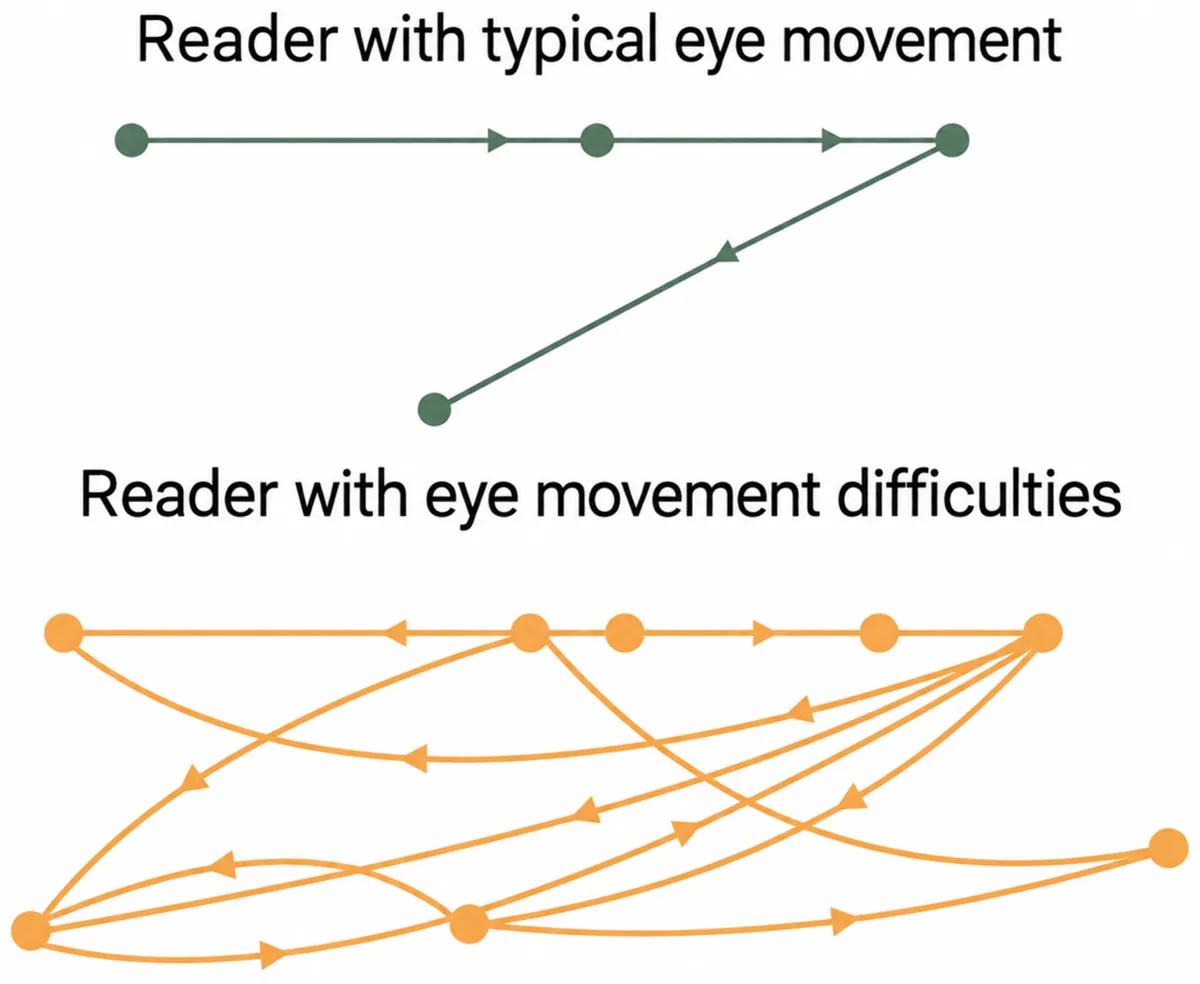
Reading requires much more than recognizing letters and sounding out words.
The eyes must repeatedly move from one location to another, hold their position long enough to process information, move accurately across lines of text together, and find the beginning of the next line.
When that process is difficult, a reader may frequently lose their place, skip or reread words or lines, become tired or frustrated while reading, or report that words are difficult to follow.
Those experiences do not prove that someone has an eye-movement problem—or explain a dyslexia diagnosis—but they can give us a reason to look more closely.
What Happens During the Reading Vision Assessment?
The Reading Vision Assessment is completed online through Zoom.
During the approximately 15-minute Assessment, a Reading Vision Assessment Specialist observes eye-movement patterns while your child completes guided visual tasks. We also include a short reading portion to help us determine their current reading level.
We're looking for observable eye-movement patterns that may be making reading more difficult than it needs to be.
After the Assessment, you'll continue the Zoom call with a Reading Vision Tutor who will explain what was observed, answer your questions, and discuss appropriate next steps.
The intent of the Assessment is not to diagnose dyslexia or a medical eye condition. If we see signs that could indicate a clinical eye condition, we'll recommend follow-up with a licensed eye-care professional.
Schedule a Reading Vision Assessment
The Reading Vision Assessment costs $125 and is completed online from home.
Have a referral or promotional code? Enter it during checkout.
What If an Eye-Movement Difficulty Is Identified?
The next step depends on what we observe.
Eyes Up Reading provides educational Reading Vision Tutoring that combines exercises that improve the eye-tracking skills used during reading and individualized reading instruction.
We do not provide optometric vision therapy, diagnose clinical eye disorders, or treat dyslexia.
A child who has dyslexia should still receive appropriate, evidence-based reading instruction for dyslexia. Our role is to determine whether an additional eye-movement difficulty may also deserve attention.
A Dyslexia Diagnosis Doesn't Mean Every Reading Difficulty Has the Same Cause
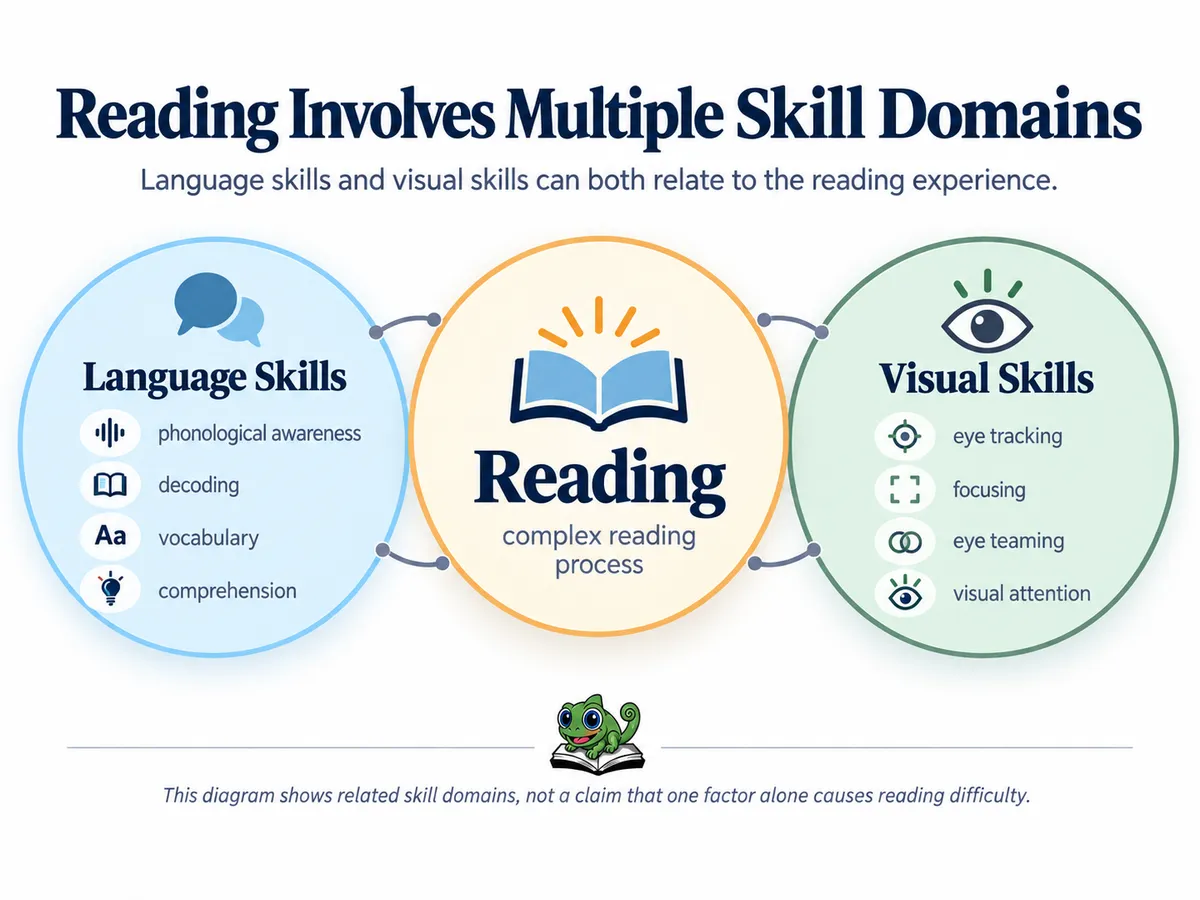
Reading is complex.
Language processing, decoding, fluency, vocabulary, comprehension, attention, visual skills, and other factors can all affect the reading experience.
The goal of the Reading Vision Assessment is simply to answer one useful question:
Could observable eye-movement difficulties be adding to the reading struggle?
If the answer is no, that's useful information.
If the answer is yes, you'll have a clearer picture of what may deserve attention next.
Schedule a Reading Vision Assessment
The Reading Vision Assessment costs $125 and is completed online from home.
Have a referral or promotional code? Enter it during checkout.
Frequently Asked Questions Regarding Dyslexia Reading Help
Does Eyes Up Reading diagnose or treat dyslexia?
No. Eyes Up Reading does not diagnose or treat dyslexia. The Reading Vision Assessment is an educational, observational assessment designed to look for eye-movement patterns that may be making reading more difficult. It is not a medical, psychological, or educational diagnosis of dyslexia.
If my child has dyslexia, why would eye tracking matter?
A dyslexia diagnosis does not tell you everything that may be affecting a child's reading experience. The purpose of the Reading Vision Assessment is to look specifically at how the eyes move while reading and determine whether eye-tracking or eye-teaming difficulties may be a contibuting factor making reading harder.
What signs might suggest an eye-tracking problem while reading?
Possible signs can include frequently losing one's place, skipping words, skipping lines, rereading text, eye strain, headaches, frustration during reading, or difficulty following words across the page. These signs do not prove that an eye-tracking problem is present, which is why Eyes Up Reading uses the Reading Vision Assessment to observe actual eye-movement patterns during reading.
Is Reading Vision Tutoring the same as dyslexia treatment?
No. Reading Vision Tutoring is educational tutoring, not clinical treatment for dyslexia. It combines individualized reading instruction with exercises that improve the eye teaming and tracking skills used during reading. Eyes Up Reading does not represent this service as treatment for dyslexia or as a replacement for evaluation or care from an appropriately licensed professional.
What if my child already receives reading or dyslexia support somewhere else?
The Reading Vision Assessment is intended to answer a narrower question: whether eye-movement difficulties may also be contributing to your child's reading struggles. The findings can help you better understand that part of the reading picture and decide what additional support, if any, makes sense.
What happens during the Reading Vision Assessment?
The Reading Vision Assessment is conducted online through Zoom. A Reading Vision Assessment Specialist observes eye-movement patterns while your child completes visual tasks. Afterward, a Certified Reading Vision Tutor discusses what was observed, answers your questions, and explains possible next steps.
Eyes Up Reading provides tutoring and educational support. We do not diagnose or treat dyslexia, ADHD, learning disabilities, strabismus, amblyopia, or other diagnosed visual disorders, and we do not provide optometric vision therapy. When clinical evaluation is appropriate, we recommend consulting a licensed eye-care professional.
LEGAL DISCLAIMER: Eyes Up Reading does not provide clinical diagnosis or prescription from state-licensed optometrists or ophthalmologists or orthoptists. We do not provide optometric vision therapy. We do not treat diagnosed visual disorders, strabismus, or amblyopia. We do not treat dyslexia, ADHD, or learning disabilities. Instead, we provide tutoring/educational intervention and we address visual-skills related to reading, particularly eye-tracking issues that may contribute to reading challenges.
If you need clinical vision therapy, please see a licensed professional.
Testimonials reflect the personal experiences and perspectives of students and families, not medical or optometric diagnoses, treatment claims, or professional medical opinions from Eyes Up Reading. Individual results may vary.
Copyright © 2026 Eyes Up Reading